
Science Applications International Corporation – Wikipedia
The original SAIC was created in 1969 by J. Robert Beyster. Then on September 27, 2013, it spun off a $4 billion unit which retained its name, while the parent company changed its name to Leidos.
https://en.wikipedia.org/wiki/Science_Applications_International_Corporation
Following the split, Anthony J. Moraco was appointed CEO of SAIC, and John P. Jumper was appointed CEO of Leidos.
The primary motivation for the spinoff was the conflicts of interest provisions in the Federal Acquisition Regulation which prevented the company from bidding on
some new contracts because of existing contracts.
John Robert Beyster (July 26, 1924 – December 22, 2014), often styled J. Robert Beyster, was an American scientist and entrepreneur, and the founder of Science Applications International Corporation.
Beyster was born in
Detroit, Michigan, in 1924, and grew up in Grosse Ile, Michigan.
Beyster worked as a scientist for Westinghouse Atomic Power Division on the company’s nuclear submarine program in the 1950s.
He soon followed many of his college associates to New Mexico to work as a research
physicist at the Los Alamos National Laboratory.
In 1957 he became the chairman of the Accelerator Physics Department of General Atomics where he remained until it was bought by Gulf Oil in 1968.
In 1969, Beyster raised money to start Science Applications, Inc. (SAI) by
investing the proceeds from selling stock he had received from General Atomic, combined with funds raised from early employees of the company.
General Atomics (GA) was founded on July 18, 1955, in San Diego, California, by Frederic de Hoffmann with assistance from notable
physicists Edward Teller and Freeman Dyson. Originally the company was part of the General Atomic division of General Dynamics “for harnessing the power of nuclear technologies for the benefit of mankind”.
Frederic De Hoffmann moved to the General Dynamics Corporation in 1955.
That year he was recruited by John Jay Hopkins to found General Atomic and serve as its first president.
De Hoffmann joined the Salk Institute for Biological Studies in 1970 and served as its president for 18 years. He was also the chairman and chief executive officer of the
Salk Institute Biotechnology-Industry Associates Inc. When de Hoffmann retired in 1988 he was named the institute’s president emeritus.
He died in 1989 of AIDS, which he contracted in 1984 from an infected blood transfusion he received during surgery.
General Atomics’s initial
projects were the TRIGA nuclear research reactor, which was designed so that it was guaranteed to be safe by the laws of nature, and Project Orion.
GA helped develop and run the San Diego Supercomputer Center.
A brief history of the company:
•1967: Sold to Gulf Oil and
renamed Gulf General Atomic.
•1973: Renamed “General Atomic Company” when Royal Dutch Shell Group’s Scallop Nuclear Inc. became a 50–50 partner.
The suit was commenced by the General Atomic Company on January 10, 1976. Named as defendants were four utility companies,
consisting of: Duke Power Company, a North Carolina corporation; Indiana & Michigan Electric Company, an Indiana corporation; Detroit-Edison Company, a Michigan corporation; Commonwealth Edison Company, an Illinois corporation; and also United Nuclear Corporation, a Delaware
corporation. Jurisdiction was sought on each of two counts, the first for statutory interpleader, and the second by suit in the nature of an interpleader. The former claim sought to determine entitlement for each of the four utility company defendants, all of whom have contracts
with General Atomic requiring the latter to supply uranium concentrates.
The several agreements were for the supply of uranium concentrate for the fabrication of cores for nuclear reactors for electric generating plants of the utility defendants. These contracts were made
between the United Nuclear Corporation (UNC) and the utility defendants in the late 1960s and early 1970s prior to the formation of General Atomic. UNC was regarded as the source of the uranium concentrate which was to be supplied under the contracts. Thereafter, UNC assigned its
rights under the so-called UNC agreements to Gulf United Nuclear Fuels Corp. which in turn assigned to General Atomic. UNC did not relinquish its duties to the utilities under the agreements.
The stakeholder, if there is one, is not General Atomic. It is United Nuclear. The
latter now holds the property and adamantly refuses to deliver it unless it gets its price.
The United Nuclear Corporation (UNC) was a diversified nuclear mining, development, and applications company based out of the United States. Formed in 1961 as a joint venture between the
•Olin Mathieson Chemical Corporation
•Mallinckrodt Corporation of America
•Nuclear Development Corporation of America
In 1996 the company was acquired by General Electric.
The United Nuclear Corporation was formed in 1961 to oversee its founding partner’s existing nuclear
projects and take advantage of the growing nuclear market in the context of the cold war. At formation, UNC began managing the Hematite, Missouri Production Plant and the New Haven Naval Products Plant previously owned by Mallinckrodt and Olin respectively.
On 13 February 1968
the company became publicly listed on the New York Stock Exchange, although the company had been an OTC stock before then. Shortly after, in June of that year, Combustion Engineering purchased 22% of UNC despite a majority of the UNC board indicating their opposition.
Combustion
Engineering was organized in 1912 through the merger of the Grieve Grate Company and the American Stoker Company, two well-known manufacturers of fuel burning equipment. The company was originally headquartered on 11 Broadway and at 43 – 5 – 7 Broad Street (Manhattan), both in
Lower Manhattan.
In 1925 C-E entered the steam boiler business, beginning with a steam boiler installed at the Ford Motor Company’s River Rouge Plant in Dearborn, MI.
During the Great Depression, C-E formed a partnership with the Superheater Company. The Locomotive
Superheater Company was founded in 1910 to further the use of superheated steam in locomotives. The Superheater Company’s primary manufacturing facility was located in East Chicago, Indiana.
C-E was one of the major suppliers of boilers for US Navy steam-powered warships,
including Liberty ships during World War II.
C-E’s nuclear power activity began in 1955 under Arthur Santry Jr. The history of the C-E Windsor, Connecticut campus dates to the early development of the nuclear submarine. From the mid-1950s through the early 1960s, Combustion
Engineering, under federal government contract, produced nuclear fuel for the US Navy’s “Nuclear Navy” nuclear submarines. Also located at the Windsor site was the prototype marine nuclear propulsion training facility known as S1C, which was designed and constructed by C-E
adjacent to its main campus.
In the 1960s, C-E began selling nuclear power steam supply systems. The first commercial nuclear steam supply system was sold to Consumers Power Company of Michigan for the Palisades Nuclear Generating Station, which is still in operation.
In the late 1960s the company supplied nuclear reactor systems and fabricated uranium fuel for electric utility companies. A joint venture was announced in April 1968, involving the Combustion Engineering Company, ?Houston Natural Gas, and Ranchers Exploration & Development.
Houston Natural Gas Corporation (HNG) was a gas utility headquartered in Houston, Texas. The company was acquired by InterNorth Inc. in 1985, with HNG executives taking top positions at InterNorth. Following the transaction, InterNorth was renamed Enron Corporation.
In 1963 HNG
acquired the Valley Gas Production Company and its pipelines, with the president, Robert R. Herring, joining the company as vice-president. He became president of the company in 1967, and chairman of the board in 1973.
Wife Joanne Herring was born Joanne Johnson in Houston, the
daughter of Maelan (McGill) and William Dunlap Johnson. Herring grew up in the city’s affluent River Oaks neighborhood, and her childhood acquaintances included James A. Baker, III, who would later serve as Secretary of State.


In 1990 C-E became a wholly owned subsidiary of Asea Brown Boveri (ABB), a Swiss-Swedish multinational conglomerate based in Zurich and one of the largest electrical engineering companies in the world.
C-E’s financial debt and lingering asbestos liability brought ABB to the brink
of bankruptcy in the early 2000s. ABB was able to resolve asbestos claims filed against Combustion Engineering and Lummus Global in 2006 with a billion-plus dollar settlement agreement.
ABB and Alstom merged their power groups in 1999 creating a 50/50 joint venture, ABB-Alstom
Power. In 2000, Alstom bought out ABB.
In 2001, the nuclear steam supply system vendor portion of the company, operating as Combustion Engineering, was bought by Westinghouse Electric Co., a then subsidiary of British Nuclear Fuels.
November 2, 2015 GE Power announced it had
completed the acquisition of Alstom’s power and grid businesses.
In 1997, General Electric acquired United Nuclear Corporation “UNC” and its debts for $330 million, with The Carlyle Group purchasing its military contract services division, UNC Aviation Services.
Carlyle was
founded in 1987 as an investment banking boutique by five partners with backgrounds in finance and government: William E. Conway Jr., Stephen L. Norris, David M. Rubenstein, Daniel A. D’Aniello and Greg Rosenbaum.
The founding partners named the firm after the Carlyle Hotel in
New York City where Norris and Rubenstein had planned the new investment business.
Frank Carlucci served as chairman of the Carlyle Group from 1992 until 2003, and chairman emeritus until 2005.
He had business interests in the following companies: Ashland Global Holdings,
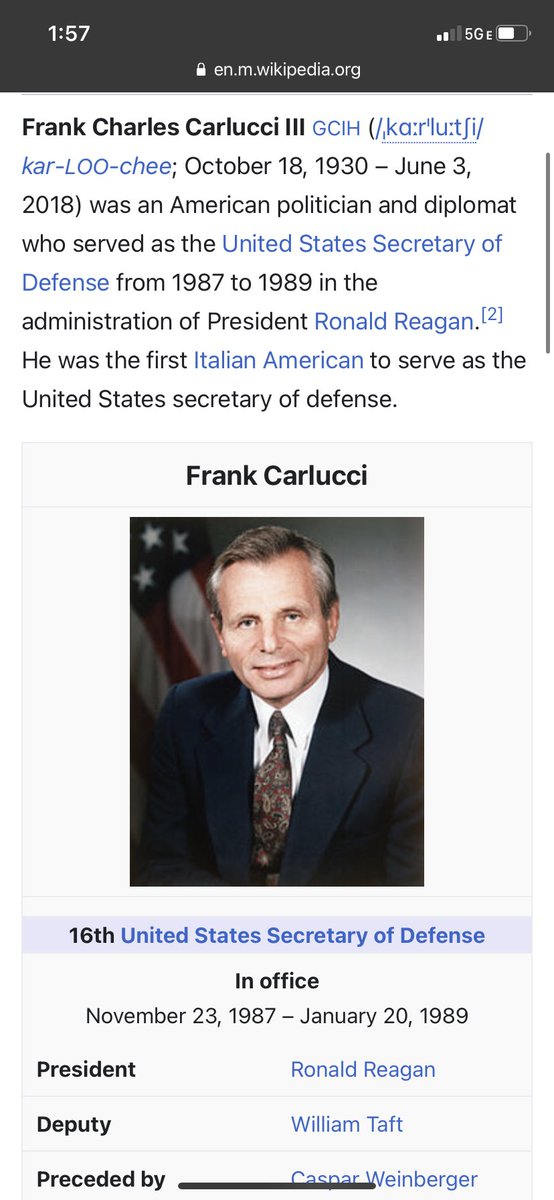
General Dynamics, Westinghouse, Neurogen, CB Commercial Real Estate, Nortel, BDM International, Quaker Oats, and Kaman.
Carlucci was at one time a director of the private security firm Wackenhut, and was a co-founder and senior member of the Frontier Group, a private-equity
investment firm. Carlucci was an advisory board member of G2 Satellite Solutions and the Chairman Emeritus of Nortel Networks.
In 1961, Frank Carlucci was the second secretary at the United States Embassy in the Congo. During that time, Patrice Lumumba, the first prime minister
of independent Congo, was executed in January 1961 during the Congo Crisis.
According to subsequently released U.S. government documents, President Dwight D. Eisenhower ordered the CIA to eliminate Lumumba. Minutes of an August 1960 National Security Council meeting confirm
that Eisenhower told CIA chief Allen Dulles to “eliminate” the Congolese leader.
In 1948, Carlucci attended Princeton University, where he roomed with Donald Rumsfeld.
Rumsfeld was designated aircraft commander of Anti-submarine Squadron 731 on October 1, 1960, at Naval Air
Station Grosse Ile, Michigan, where he flew the S2F Tracker.
Former President George H. W. Bush finished his active Navy career at NASGI attached to Torpedo Squadron 153(VT-153).
The original SAIC was created in 1969 by J. Robert Beyster. Beyster was born in Detroit, Michigan,

in 1924, and grew up in Grosse Ile, Michigan.
Rumsfeld recruited a young one-time staffer of his, Dick Cheney, to succeed him when Ford nominated him to be Secretary of Defense in 1975. When Ford lost the 1976 election, Rumsfeld returned to private business and financial life,
and was named president and CEO of the pharmaceutical corporation G. D. Searle & Company. He was later named CEO of General Instrument from 1990 to 1993 and chairman of Gilead Sciences from 1997 to 2001.
Searle is most notable for having developed the first female birth control
pill, and the artificial sweetener NutraSweet.
Between 1977 and 1985, Donald Rumsfeld served as CEO, and then as president, of Searle. During his tenure, Rumsfeld reduced the number of employees in the company by 60%. In 1985, he engineered the acquisition of Searle by Monsanto
Corporation.
In 1923 Charles F. Kettering and Carroll A. “Ted” Hochwalt recruited Charles Allen Thomas to work as a research chemist at General Motors (GM). There, he worked with Thomas Midgley, Jr., as part of Kettering’s team researching antiknock agents. Thomas married
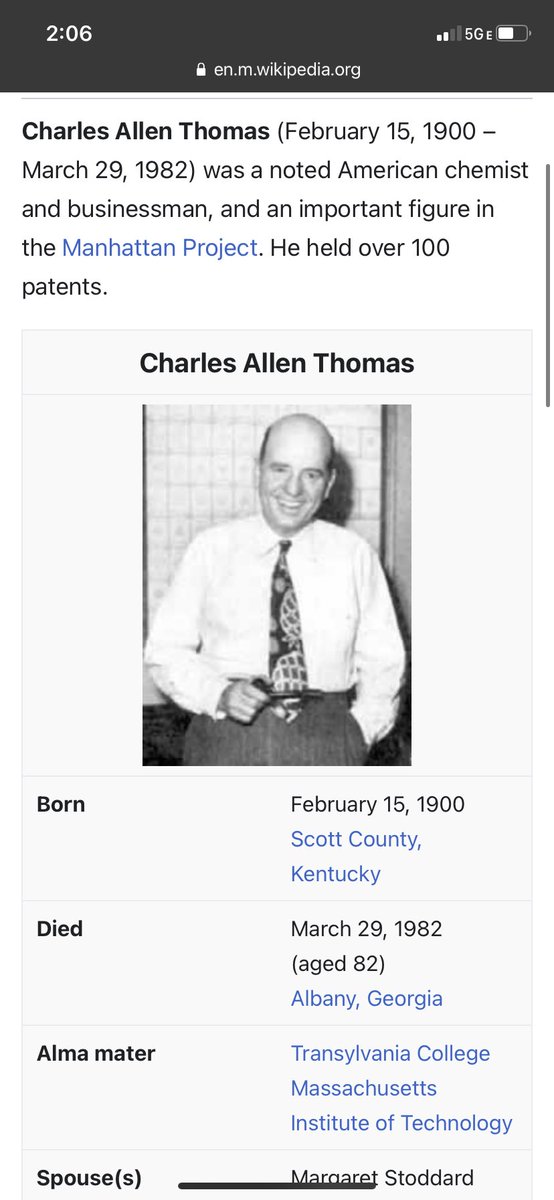
Margaret Stoddard Talbott, the sister of Harold E. Talbott, Jr. (great-nephew=Strobe Talbott ) on September 25, 1926.
Their work attracted the attention of Edgar Monsanto Queeny, the chairman of Monsanto, who bought Thomas & Hochwalt Laboratories for $1.4 million in Monsanto
stock in 1936. Queeny moved Thomas to St Louis, Missouri.
Monsanto’s Central Research Department began to conduct research on behalf of the Manhattan Project as part of the Manhattan Project’s Dayton Project, some of which was conducted on the estate of his wife’s family.
In
May 1947, he decided not to renew the contract with the Atomic Energy Commission to operate the Clinton Laboratories on a month-to-month basis while a new operator was found. Union Carbide took over the contract in December 1947. Monsanto was, however, given the contract to
operate the new Mound Laboratories in early 1948.
In 1946 Secretary of State Dean Acheson appointed Thomas to serve on a panel with Robert Oppenheimer, David Lilienthal, Chester I. Barnard and Harry Winne to appraise international atomic inspection, culminating in the
Acheson–Lilienthal Report. In 1951 Truman appointed Thomas to the Science Advisory Committee, an eleven-man committee of prominent scientists to advise on defense planning. In 1953 President Dwight D. Eisenhower appointed him a scientific consultant to the National Security
Council, and he was the U.S. Representative to the United Nations Atomic Energy Commission.
In the wake of the Sputnik crisis, Thomas was part of a group that persuaded Secretary of Defense Neil H. McElroy to establish DARPA.
A proposal to pass the responsibility for the
control of atomic energy to a United Nations Atomic Energy Commission was endorsed by both the USA and the Soviets in 1945.
On 14 December 1946, the General Assembly passed a follow-up resolution urging an expeditious completion of the report by the Commission as well as its
consideration by the United Nations Security Council.
The Report on the International Control of Atomic Energy, commonly known as the Acheson–Lilienthal Report, was written by a United States committee in 1946 and discussed possible methods for the international control of
nuclear weapons and the avoidance of future nuclear warfare. The report was produced by the Committee on Atomic Energy, headed by Dean Acheson and David Lilienthal, and was mostly written by scientist Robert Oppenheimer.
On July 29, 1957 the International Atomic Energy
Agency (IAEA) was established. However, the concept that the IAEA would serve as a bank of nuclear materials, drawing down US and Soviet stocks below the level where either could launch a knock-out blow against the other.
As of March 2011 the IAEA Board of Governors has
approved the creation of two separate fuel banks. The first, formally established by the IAEA and the Russian government in March 2010, is owned, operated, and paid for by the Russian Federation and located near the Siberian city of Angarsk.
In May 2015, the IAEA approved a
Host-State Agreement with Kazakhstan, paving the way for Kazakhstan to host the LEU Bank. The plans call for having Russia enrich the uranium before it is stored.
Kazatomprom proposed at the 2013 IAEA General Conference that Kazakhstan host the LEU bank at its Ulba Metallurgical Plant.
The LEU bank is under construction in Ust-Kamenogorsk, Kazakhstan under the aegis of the IAEA.
In addition to the two fuel banks, the Russian Federation
has also established an International Uranium Enrichment Center (IUEC) located at Angarsk. The IUEC is set up as a joint stock company between Russia’s Rosatom Corporation holding 80% of the shares, Kazakhstani and Ukrainian corporations, while the government of Armenia slated to
join the company in the future.
The Washington-based Nuclear Threat Initiative’s proposal for an international fuel bank announced an initial $50 million grant to the IAEA contingent upon an additional $100 million from other sources. The United States has offered $50 million,
the United Arab Emirates has pledged $10 million, Norway has promised $5 million and the European Union agreed to provide up to 25 million euros (about $32 million in May 2009). The fuel bank therefore reached its initial funding target in March 2009.
Former Senator Sam Nunn, a
co-Chairman of the Nuclear Threat Initiative, said in a speech announcing the NTI pledge that “we envision that this stockpile will be available as a last-resort fuel reserve for nations that have made the sovereign choice to develop their nuclear energy based on foreign sources

of fuel supply services-and therefore have no indigenous enrichment facilities.” Warren Buffett, a key NTI advisor, is financially backing and enabling the commitment. “This pledge is an investment in a safer world,” Buffett said.
